Rat Holes in Your Philadelphia Yard: What They Mean and What to Do
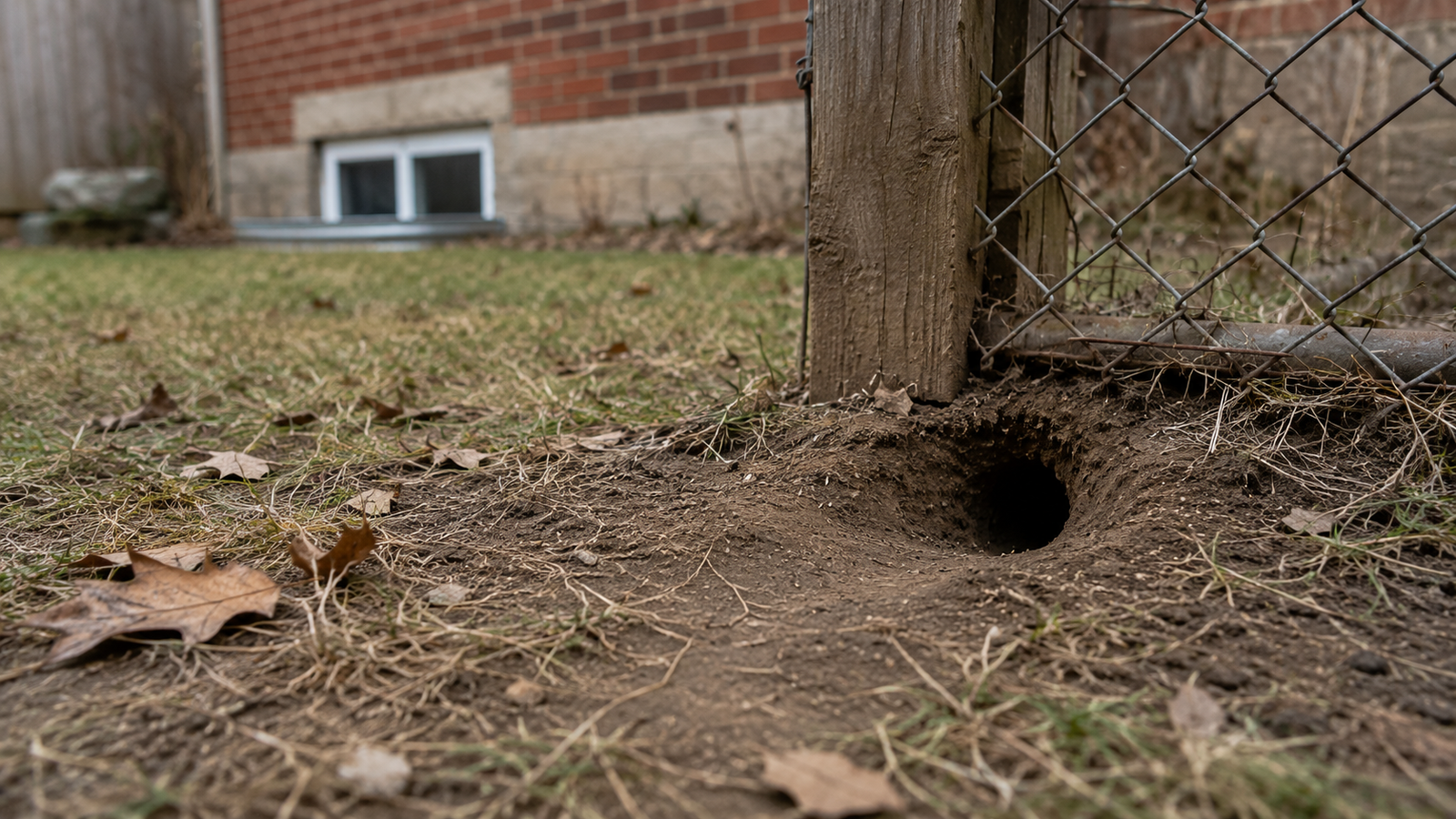
Round smooth holes about 2 to 4 inches wide in a Philadelphia yard, especially along fence lines, foundations, or under sheds and decking, are almost always rat burrows. An active burrow has clean edges, packed-down dirt around the opening, a visible rat trail leading to it, and often fresh droppings nearby. Rat burrows should never be sealed shut before trapping and baiting, or the rats will chew their way out through a wall or floor of the building.
Finding holes in your yard is one of the most common first signs of a Philadelphia rat problem. The good news is that yard burrows are much easier to identify and treat than an established indoor infestation, if you know what to look for. This guide covers exactly how to identify a rat burrow, how to tell if it is active, and what to do (and what not to do) once you find one.
What a rat burrow actually looks like
Rat burrows in Philadelphia yards have consistent physical features that make them easy to identify once you know the signs. A typical rat burrow entrance is round to slightly oval, roughly 2 to 4 inches in diameter, with clean smooth edges and packed-down dirt around the opening. The hole angles downward into the ground rather than going straight down, and the tunnel behind it usually extends 12 to 36 inches before opening into a nesting chamber. Active burrows often have one main entrance and one or two smaller "bolt holes" nearby that the rats use as emergency exits.
How to tell if a rat burrow is active
Signs a burrow is currently in use:
- Clean, smooth edges with no leaves, spider webs, or debris blocking the opening
- Packed-down dirt or a small mound of fresh soil around the entrance
- A visible rat trail (a narrow path of flattened grass or worn dirt) leading to the hole
- Fresh droppings within a few feet of the entrance (dark, moist, roughly 1/2 to 3/4 inch long)
- Grease marks along walls, fences, or objects near the trail
- A slight ammonia or musky smell near the opening
- If you loosely block the hole with a wad of paper or leaves, it is re-opened within 24 hours
Signs a burrow is abandoned:
- Spider webs, dry leaves, or debris covering the opening
- Grass growing over the entrance
- No fresh droppings within several feet
- Rounded, weathered edges rather than clean sharp edges
- A paper or leaf plug stays in place for several days without being cleared
An abandoned burrow can still be filled in for safety and aesthetic reasons, but it does not need immediate treatment. An active burrow requires action, and the order of that action matters.
Rat burrows vs other holes: what you might actually be seeing
Not every hole in a Philadelphia yard is a rat burrow. A few common look-alikes:
Chipmunk holes
Smaller (1 to 2 inches), often in wooded or brushy areas, and typically with no dirt mound around the entrance. Chipmunks are less common in dense Philadelphia rowhome neighborhoods but appear in Germantown, Chestnut Hill, and the northwest neighborhoods with more tree cover.
Vole tunnels and surface runways
Voles create surface runways in lawn grass (visible as narrow flattened paths under the grass) rather than open burrows, and their entrance holes are much smaller (1 inch or less).
Groundhog burrows
Much larger (8 to 12 inches in diameter) with a prominent dirt mound. Groundhogs are rare in dense Philadelphia but appear on the edges of the city.
Skunk or raccoon digging
Irregular shallow depressions rather than clean round holes, usually with visible claw marks and torn-up sod. These animals dig for grubs, not to nest.
Cicada or wasp holes
Very small (less than an inch), often clustered in bare patches of yard. Not a rodent issue.
If the hole you found is round, smooth-edged, 2 to 4 inches wide, and near a foundation, fence, shed, or dumpster area, it is almost certainly a rat burrow.
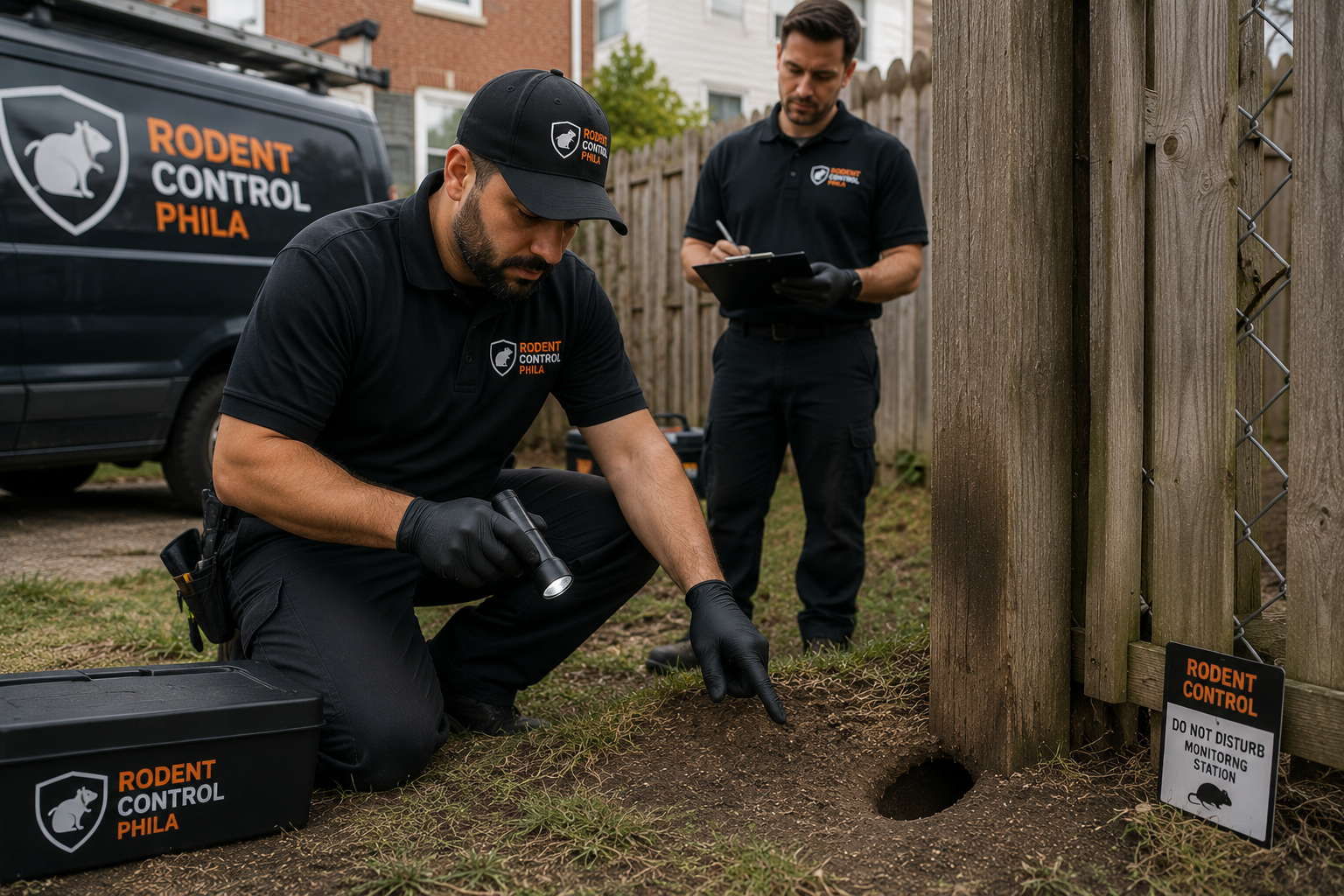
Where Philadelphia rat burrows appear most often
The Philadelphia yard locations we find rat burrows in most often:
- Along fence lines, especially fences facing a vacant lot, commercial alley, or unmaintained neighboring yard
- Under decks, stoops, and wooden steps
- Under garden sheds, especially older wooden ones sitting directly on dirt
- Behind and under compost bins
- Near trash bin storage areas and dumpster corrals
- Along the foundation of the house, especially where flower beds or ground cover meets the wall
- Under overgrown shrubs, ivy, or tall grass that provides continuous cover
What to do (and not do) when you find a rat burrow
Do not fill or seal the burrow shut as your first step. Rats trapped in a sealed burrow will dig laterally to escape and often end up chewing their way into the foundation or through a wall of the building. Filling the burrow only works after the rats have been trapped or baited out.
Step 1: Confirm the burrow is active
Use the checklist above. If it is active, proceed. If it is abandoned, you can fill it in.
Step 2: Photograph and note the location
Take photos and note where the burrow is relative to the property. This helps a pest control provider plan treatment and also documents the situation if the rats are coming from a neighboring property that needs to be reported to 311.
Step 3: Look for the food source
Rats do not burrow far from a reliable food source. Check for unsecured trash, pet food left out, bird feeders with dropped seed, open compost, or a neighbor's food source. Our full guide on what attracts rats and mice covers the full list.
Step 4: Deploy tamper-resistant bait stations or professional trapping
Place locked tamper-resistant bait stations along the rat trail and near the burrow entrance. Open snap traps or open bait in a yard is not appropriate because of the risk to pets, children, and non-target wildlife. This is where most homeowners bring in a professional.
Step 5: Wait for activity to stop before sealing
After bait consumption has stopped and no fresh droppings or trail activity appear for a week, the burrow can be filled with soil, gravel, or hydraulic cement (near a foundation). Never seal a burrow while activity is still present.
Step 6: Seal the entry points on the building
Rats using a yard burrow are almost always testing the building for entry as well. Sealing the foundation, basement, and rear yard entry points on the structure is what prevents the next wave from setting up. Our guide on how to rodent-proof your Philadelphia basement covers this in detail.
Why professional treatment for yard burrows makes sense
DIY treatment of yard burrows has two specific challenges. First, open bait in a yard is a safety risk for pets, children, and wildlife, and tamper-resistant bait stations are more expensive and less accessible than snap traps. Second, most Philadelphia yard rat problems are connected to a larger neighborhood population that treatment on a single property only partially addresses. Professional rat control handles the safety concerns, addresses burrows and building entry points at the same time, and provides written documentation useful for 311 reports against neighboring problem properties.
Found rat burrows in your yard?
Free inspection to confirm activity, safe treatment, and building exclusion in one visit.
Call (267) 501-1576 Or request your free rodent inspection onlineFrequently asked questions
How can I tell if a hole in my yard is a rat burrow or something else?+
Rat burrows are round to slightly oval, roughly 2 to 4 inches wide, with clean smooth edges and packed dirt around the opening. They angle downward and usually appear near foundations, fence lines, sheds, or trash areas. Smaller holes (under 2 inches) are usually chipmunks or voles; larger holes (over 8 inches) with a big dirt mound are groundhogs.
Should I fill in a rat burrow?+
Not while it is active. Rats trapped in a sealed burrow will dig laterally and often end up chewing into the foundation or wall of a building. Fill the burrow only after activity has stopped for a week (confirmed by no fresh droppings, no re-opening of a paper plug, and no bait consumption).
Can I use rat poison in my yard?+
Open rodenticide in a yard is not appropriate because of the risk to pets, children, and non-target wildlife. Professionals use locked tamper-resistant bait stations, which contain the bait inside a housing that only rodents can access. Open bait is one of the most common causes of accidental pet poisoning.
Will filling the burrow with water flood the rats out?+
Sometimes, but it is not a reliable solution. Rats often have bolt holes and connecting tunnels, so flooding one entrance can send them into the building through a lateral escape route. Flooding also can damage foundation walls if the burrow is close to the house. Use professional trapping and baiting instead.
How many rats live in one burrow?+
A single burrow system typically houses a family group of 5 to 10 rats, though larger connected systems can support colonies of 20 or more. Multiple visible burrow entrances on a property often connect underground into one system rather than being separate colonies.
This guide describes typical rat burrow identification and treatment for Philadelphia yards. Every property is different. Call (267) 501-1576 for a free inspection and a specific plan for your address.